The trading day ends and the second job starts. Takings typed into a spreadsheet, mostly. Supplier invoices in a pile. A roster to redo because someone swapped. Three reviews to answer. A post you meant to put up on Thursday.
None of it is hard. All of it is relentless, and it happens after a day on your feet.
This is a practical guide to which of that a cafe can reasonably hand to AI, which parts you should keep, and where to start so you get an hour back before you decide whether any of it is worth continuing.
The jobs worth handing over
The monthly numbers. The sales sheet turned into something readable. Which line is carrying the business, what the average trading day looks like now, how this month compares to the last few. This is the best starting point and I will come back to it.
Supplier invoices into a cost picture. What you actually paid for coffee, dairy and food this month against last, and which line moved. Most cafes discover a price rise weeks after it started.
Roster against takings. Not writing the roster, which needs to know that Tuesday's staff member cannot open. Comparing what you spent on staff against what came through the till, by day, so you can see which shifts are underwater.
Review responses. Drafted in your voice, ready for you to read and post. The ones that need care are the bad ones, and those are exactly the ones people leave for a week.
Specials and menu decisions from your own data. Which items are quietly not selling. What sold when the weather turned. What you ran last winter that worked.
The recurring writing. Social captions, the note to staff, the email to your accountant with the same attachments every month.
Waste and stock notes. Turning a scribbled list into something you can compare month to month, which is where the money hides in a cafe.
What to keep
Anything about a person. Rosters, performance, the conversation with the staff member who has been late three times. Not because a tool cannot draft it, but because handing that over is the wrong thing to do to someone who works for you.
Menu and pricing judgement. Data tells you the toastie is not selling. It does not know you keep it because your regulars order it and they bring people. Numbers inform this decision, they do not make it.
Anything a customer will read that is emotionally charged. A complaint, a bad review with a real grievance in it. Draft it if you like, but read it as yourself before it goes anywhere.
Your food. Obviously, and worth saying, because plenty of marketing for hospitality implies AI can do more of the actual business than it can.
Start with the Sunday hour
Pick the job you do most that you least enjoy. In almost every cafe that is the monthly numbers, so that is the one worth setting up first.
Strip that job back and you are doing four mechanical things. Reading twenty or thirty rows. Multiplying quantity by price and checking it against whatever was typed in the total column. Grouping by line so you can see coffee against food against the odd catering job. Comparing this month to the last few.
Not one of those requires you. What requires you is deciding what to do about the answer, and that takes about five minutes.
The bit that decides whether it is safe
Your sheet is not clean, and that is the point. There are blanks where a total should be, a cell that says "approx 40", a catering job with a flat amount and no quantity.
A tool that guesses gives you a tidy dashboard with a confident total. You will never know which parts were invented, and you will make a decision on it. That is worse than no dashboard.
What you want looks like this.
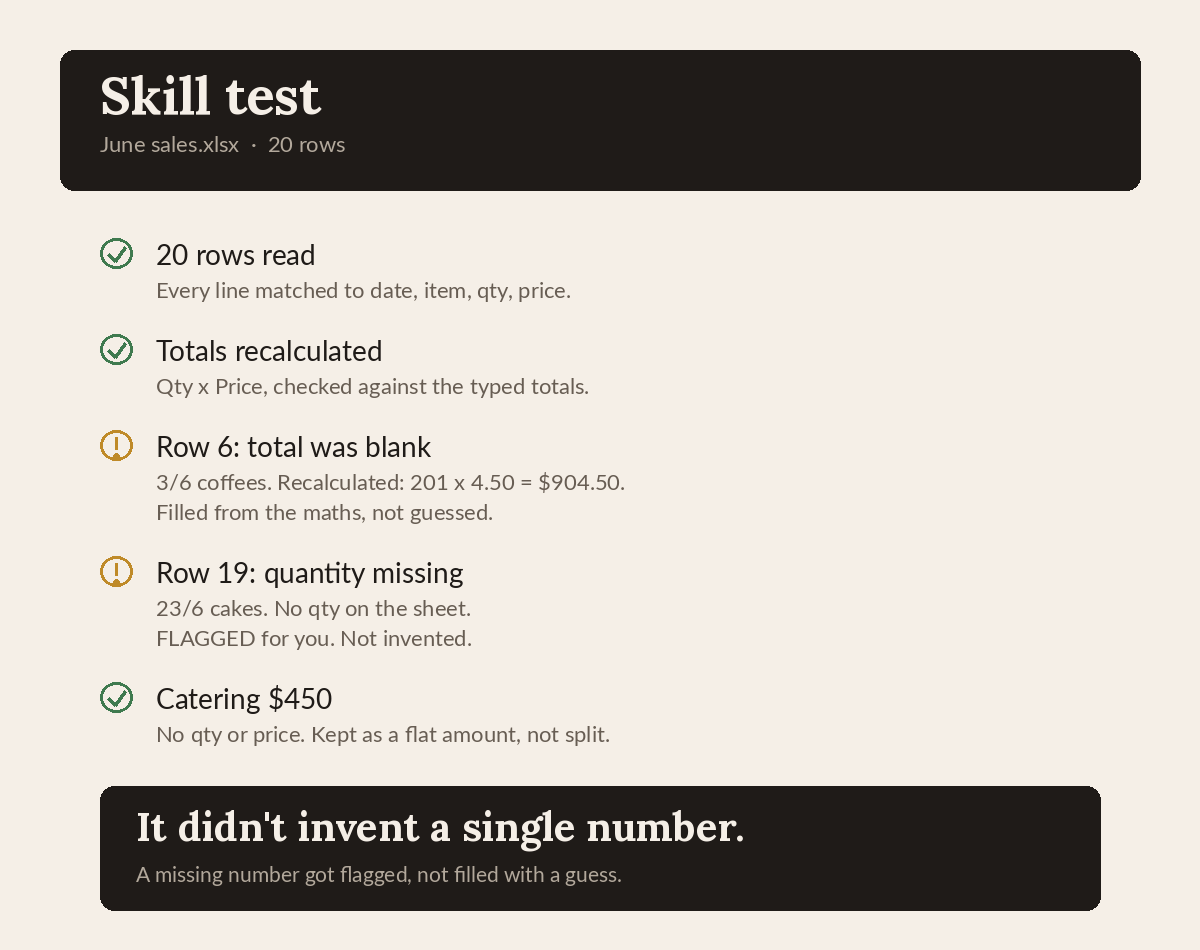
The blank total was recalculated from quantity times price, and it says so, so you can check the arithmetic yourself. The missing quantity was flagged and left alone rather than estimated. The catering job was kept as a flat amount instead of being split into a fake per unit price.
It did not invent a single number. That is the difference between a report you can act on and a report you have to audit, which would put you back where you started.
Test this before you rely on it. Give it last month's sheet, blanks and all, and ask which rows it could not read properly. If it hands you a confident total and mentions nothing, you have learned something useful in under a minute.
What to have ready
An hour of preparation decides whether any of this is worth having.
- Three months of sales sheets, messy ones, so it learns the shape of your actual data rather than an ideal version. - Your menu with prices, current. - What you want to see. Total, best seller, average trading day, week by week trend. Decide this rather than accepting whatever it produces. - Your rules. Never guess a missing number. Keep catering separate from trading days. Whatever matters to how you read the business. - What normal looks like. A good week, a bad week, roughly. Without this it has no idea whether to flag something.
Why set it up once rather than ask each month
You could paste the sheet in every month and ask nicely. It would mostly work, and you would still be spending the time, and checking carefully each time because nothing guarantees it did the same thing it did last month.
Set up properly, the instruction is written once. This is the shape of my sheet, these are the lines I care about, this is what to do when a number is missing, never guess a price. After that it runs the same way every month, including the months you are too flat out to check it properly. Consistency is the real product here, more than speed.
Next month becomes one line. Here is June, run it.
What you actually get back
An hour a month is fifteen hours a year, which is not life changing on its own.
The thing worth more is that you start looking at the numbers, because looking is now free. Most small businesses do not have a monthly numbers habit, and the reason is the preparation, not the reading. Take the preparation away and you notice that Tuesdays have gone soft, or that food is quietly carrying the week, three months earlier than you otherwise would.
One thing to be clear about. The tool reads and prepares. It does not touch your accounting, it does not send anything to anyone, and it tells you where it was unsure. You read it and decide what it means.
Start with the sales sheet. Test it on a messy month. Add the cost picture once that one is running.
If you would rather have it set up properly and tested rather than build it yourself, that is what I do for small businesses. The short intake at quietcontent.com.au is where to start.